
The right creative partner does more than deliver the next project. They help you understand what should change, what should stay, and what will create the greatest value over time.
Every organization eventually reaches a point where it needs creative support. Sometimes the need is obvious: a new website, a brand refresh, a product launch, a funding milestone, or a campaign that has to perform. Other times, the signal is harder to name. The organization has grown, but the brand has not kept pace. The work has become more sophisticated, but the way it is presented no longer feels as credible, clear, or consistent as the business itself.
That is usually when the search for a creative partner begins. Portfolios, capabilities, chemistry, timing, and price all matter, but they rarely determine the success of the work on their own. The more important question is often much simpler: where does the conversation begin?
Some firms begin with deliverables. The strongest creative partnerships begin by understanding the organization behind them—its goals, audiences, challenges, opportunities, and what success should look like long after the project is complete. That distinction can change the entire trajectory of the work.
Something has changed. That is usually the real beginning.
Organizations rarely wake up one morning and decide, without context, that they need a rebrand or a new website. Something has usually shifted. You may be entering a new market, preparing for investment, introducing a new product, expanding into new services, recruiting at a different level, or speaking to an audience that did not exist when the current brand was created.
Sometimes the change is internal. Teams have grown, leadership has evolved, or different departments have begun describing the organization in different ways. Sometimes it is external: customers expect more sophisticated digital experiences, competitors have changed the category, or the ways people discover and evaluate organizations have moved beyond the traditional website and search result.
The right time to invest is not determined by the age of a logo or website. It is determined by whether the brand and experience surrounding the organization still support where the business is going. A five-year-old identity may still be doing its job beautifully. A two-year-old website may already be holding the organization back.
Before choosing a firm, understand the problem you are actually trying to solve.
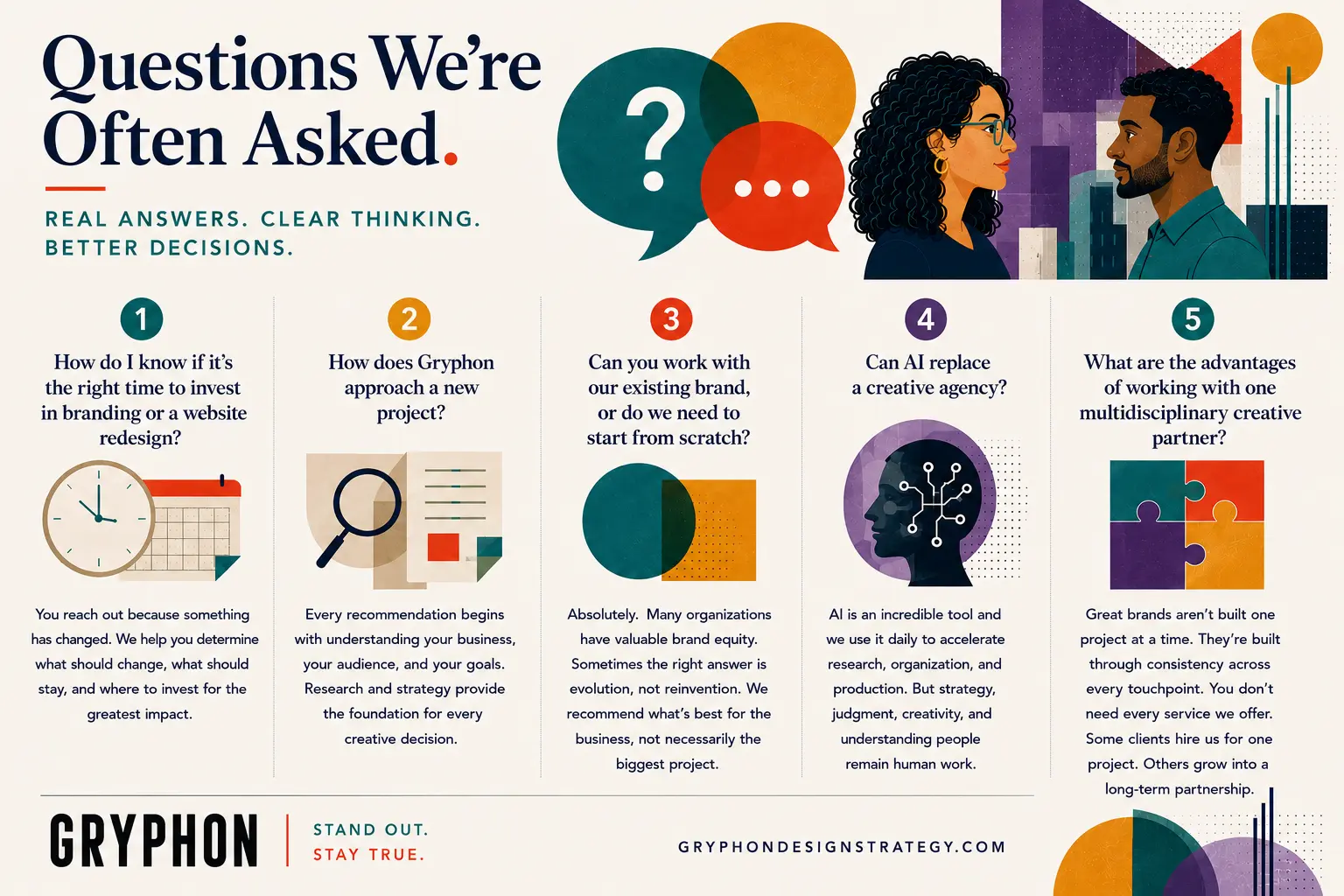
One of the most useful things a creative partner can do is help separate the requested deliverable from the underlying business problem. A client may come in asking for a website redesign when the deeper issue is unclear positioning. Another may assume the logo needs to change when the real opportunity is stronger messaging, better content architecture, or a more consistent system around an identity that still has significant equity.
The reverse is also true. Not every challenge requires a broad transformation. Sometimes the right solution really is a focused website, presentation, campaign, or identity refinement. We have always believed that good advice includes the willingness to say when something does not need to change.
That is an important distinction because strategy is not about making a project larger. It is about making the investment more intentional. When the problem is clearly understood, creative decisions become easier to evaluate and the work becomes more useful. A website does not simply look better; it communicates more clearly. A brand does not simply become newer; it becomes more relevant, recognizable, and coherent. Marketing works harder because the pieces are connected by a shared purpose.
A practical check: is it time to invest?
You do not need to check every box below. Think of these as signals worth paying attention to, especially when several are happening at once.
- Your organization has changed significantly, but your brand has not.
- Prospective customers, partners, investors, or employees do not immediately understand what you do or why it matters.
- Your website no longer reflects the quality, scale, or sophistication of the organization behind it.
- Sales, recruiting, marketing, presentation, and digital materials feel as though they came from different organizations.
- Your team repeatedly recreates materials because there is no clear, usable system to work from.
- You are entering a new market, speaking to a new audience, launching something important, or preparing for a major business milestone.
- Different people inside the organization describe the brand, value proposition, or offering differently.
- You hesitate before sending someone to your website or sharing a presentation because it no longer represents the organization well.
- Your brand still has equity, but the system around it is making growth harder rather than easier.
Checking one box does not automatically mean you need a rebrand. It means there may be a gap between the organization you have become and the way people experience it. The next step is understanding the size and nature of that gap before deciding what to change.
What should you look for in a creative partner?
A portfolio can tell you whether you like the work. It cannot tell you how the work was created, how the team responded when the problem changed, or whether the final system still served the client years later. Those qualities usually become visible in the questions a potential partner asks and the way they think about the engagement.
- They ask about business goals before talking about aesthetics.
- They want to understand the people you are trying to reach, not just the people approving the work.
- They can explain why they are recommending a particular direction and connect creative decisions to a larger objective.
- They are comfortable preserving what is already working rather than redesigning for the sake of novelty.
- They understand how positioning, messaging, visual identity, websites, content, accessibility, and marketing affect one another.
- Experienced leadership stays involved in the work rather than disappearing after the pitch.
- They create tools and systems your internal team can actually use after launch.
- They can tell you when a smaller, more focused engagement is the smarter investment.
What experience has taught us
Across more than fifteen years of work, we have seen the same pattern in organizations of very different sizes and sectors: the request that begins the conversation is not always the problem we ultimately solve. A startup preparing to meet investors may ask first for a presentation, but the work often reveals that positioning, narrative, and visual credibility need to align across every investor touchpoint. An established healthcare organization may begin with a website request, only to discover that years of growth have created fragmented messaging that must be clarified before a new digital experience can succeed.
In other situations, the opposite is true. A long-standing organization may already possess meaningful recognition and equity. The smartest move is not to erase that history, but to preserve what people know and trust while strengthening the system around it. The creative partner's job is not to arrive with a predetermined answer. It is to help the organization see the problem clearly enough to choose the right one together.
That is also why collaboration matters. Internal teams hold knowledge an outside partner cannot manufacture: history, customer relationships, culture, political realities, operational constraints, and lived experience. A strong creative partner brings a different kind of value—outside perspective, pattern recognition, specialized expertise, and the ability to connect decisions that may otherwise be made in isolation. The best outcomes happen when those strengths work together.
The difference is not just better design. It is better communication.
At Gryphon, we have found that the strongest work comes from curiosity, collaboration, and a genuine investment in understanding what success means for the organization—not from applying the same process to every client. Every organization is different, and every engagement deserves a thoughtful approach rather than a predetermined package.
Great creative is not measured only by what gets delivered on launch day. It is measured by how well the work continues to serve the organization months and years later: whether teams can use it confidently, whether customers understand the value more quickly, whether the brand can flex as new opportunities emerge, and whether the organization is showing up with the clarity and credibility its work deserves.
The right creative partner does not simply help you complete your next project. They help you make better decisions about what comes next, build a stronger foundation for growth, and create a system that can continue working long after the first deliverable is finished.
FIELD NOTE
Before you begin searching for an agency, write down what has changed in your organization and what you hope will be different a year from now. Do not start with the deliverable. Start with the outcome. The right creative partner can help you determine what needs to happen in between.