
How to build the right creative support model as your organization grows.
As organizations grow, so do their creative needs. A new website launches, marketing campaigns become more frequent, sales teams need presentations, product teams need graphics, events require signage, and social media demands a steady stream of content. Internal communications compete for attention alongside customer-facing initiatives, and what once felt manageable can quickly become a much more connected creative ecosystem.
Eventually, many organizations ask the same question: Should we build an internal creative team or hire an agency? It is a smart question, but the answer is not always one or the other. More organizations are finding value in a third option—one that pairs the continuity of an internal team with the expertise and flexibility of an experienced creative partner.
Every Model Has Strengths
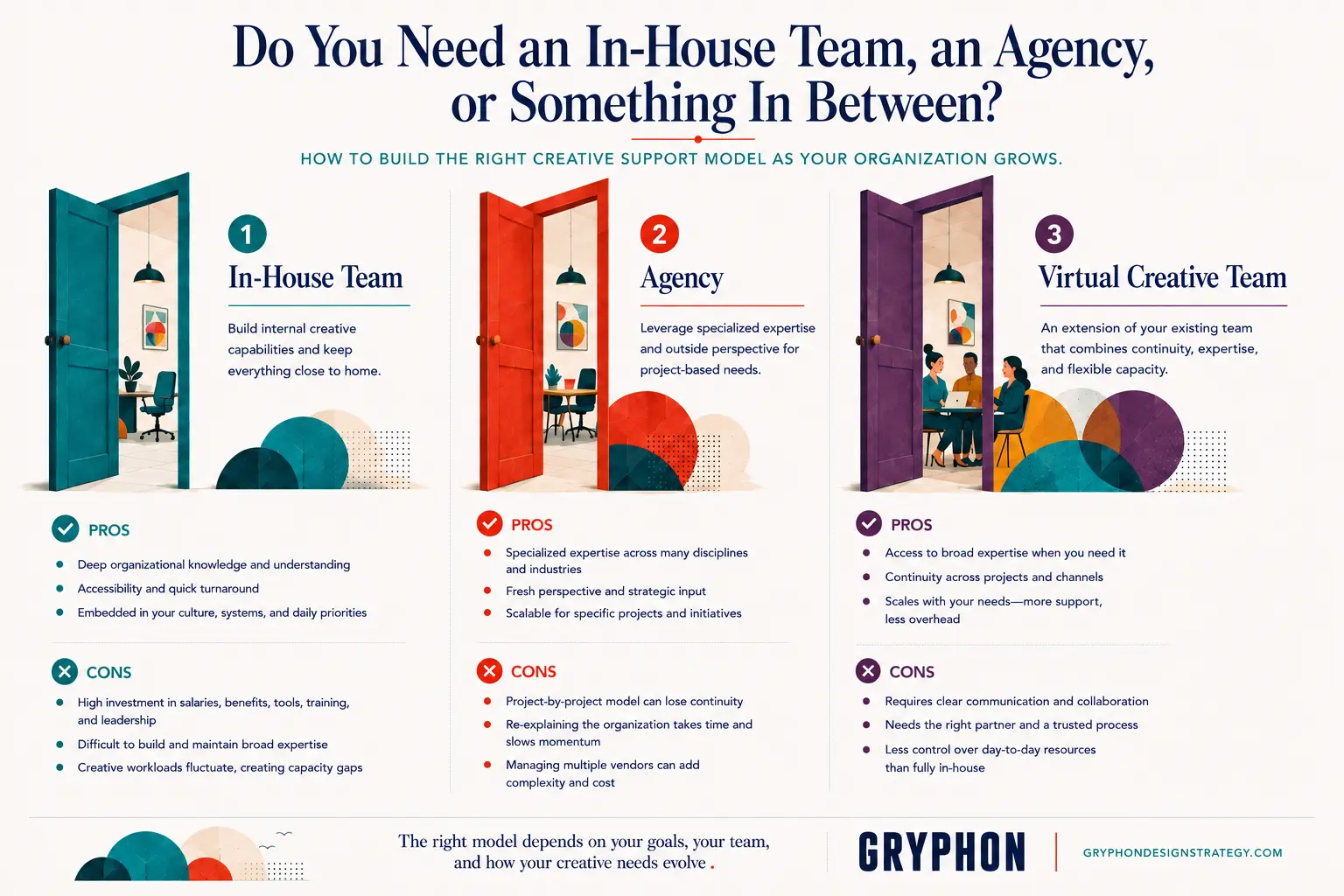
An internal creative team offers accessibility and deep organizational knowledge. Team members understand your culture, your people, your systems, and the day-to-day priorities that shape the work. An agency brings something different: strategic perspective, specialized expertise, and experience solving similar challenges across many organizations and industries.
Both approaches create tremendous value, and both have limitations. The better question is not which model is universally best. It is which combination of continuity, expertise, capacity, and flexibility best matches what your organization actually needs.
The Challenges of Building an Internal Team
Building a creative department involves much more than hiring a designer. Organizations may need strategists, writers, UX specialists, web designers, developers, accessibility experts, creative directors, and project management—often at different moments and in different combinations.
Maintaining that breadth of expertise internally requires significant investment, not only in salaries and benefits but also in software, training, leadership, and recruiting. Creative workloads fluctuate, too. Some months may require the energy of an entire team; others may call for one highly specialized skill. Building permanent infrastructure around variable demand is not always the most efficient answer.
The Challenges of Traditional Agency Relationships
Traditional agency engagements are often built around individual projects: launch a website, complete a rebrand, deliver a campaign, then move on. That model works well when the need is discrete and the finish line is clear.
But many organizations do not work that way. Marketing evolves, websites require updates, sales teams need presentations, events appear throughout the year, and new initiatives emerge unexpectedly. Managing each request as a separate project—or across multiple vendors—can create unnecessary complexity. Context gets lost, teams spend time re-explaining the organization, and momentum has to be rebuilt with every new engagement.
The Space Between
Many organizations find themselves somewhere in the middle: too much work for a freelancer, not enough consistent demand to justify a full internal creative department, an experienced marketing team that occasionally needs specialized support, or perhaps no internal creative resources at all.
This is where a Virtual Design Team provides a different approach. It creates an ongoing creative relationship without requiring an organization to hire every specialty or restart the learning process whenever the need changes.
What Is a Virtual Design Team?
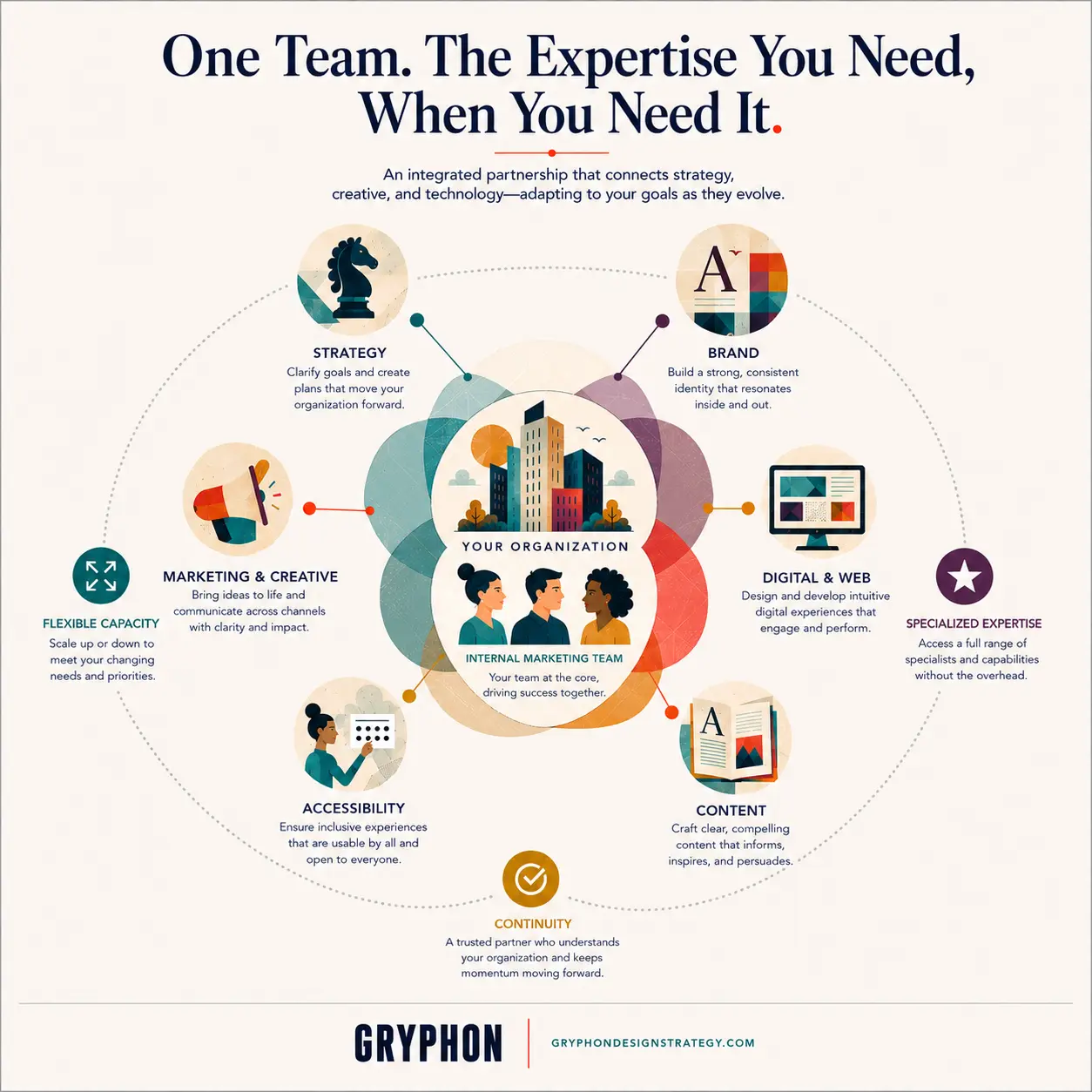
Think of it as an extension of your organization. Rather than hiring multiple specialists—or juggling a mix of separate agencies and freelancers—you gain ongoing access to an integrated team that can support a broad range of strategic and creative needs while carrying knowledge from one initiative into the next.
- Brand strategy
- Visual identity
- Websites and user experience
- Content and accessibility
- Marketing communications and digital campaigns
- Creative design, presentations, and print
The value is not simply the breadth of deliverables. It is the strategic thinking that connects them. You are not purchasing a collection of isolated services; you are building an ongoing creative partnership with people who understand the larger system around the work.
Is It the Right Fit?
A Virtual Design Team is not designed for every organization. It is most valuable when creative needs evolve throughout the year: strategic planning one month, a website initiative the next, followed by a conference, product launch, investor presentation, recruitment campaign, or annual report.
Instead of hiring for every specialty—or starting over with a new vendor each time—you have a trusted partner who already understands your organization and can scale support as priorities change. That continuity can be particularly valuable when the work crosses channels, because decisions made in one place can inform what happens everywhere else.
Working Alongside Your Internal Team
Many organizations already have talented marketing professionals, and a Virtual Design Team is not there to replace them. It is there to strengthen them. Some clients rely on an outside partner for strategic leadership; others need specialized design or digital expertise, and some simply need additional capacity during busy periods.
The partnership adapts to complement the team that already exists—filling gaps, extending capabilities, and giving internal leaders access to the right expertise without requiring every capability to live permanently in-house. At its best, the distinction between “internal” and “external” becomes less important than whether everyone is working toward the same goals.
A Partnership That Grows With You
Creative partnerships should not remain static because organizations do not remain static. New products launch, teams expand, priorities shift, budgets change, and new opportunities appear. The support model that worked two years ago may not be the one that makes sense today.
A Virtual Design Team provides the flexibility to adjust engagement levels, expand services, or shift priorities without rebuilding your creative infrastructure every time the business changes. The goal is not to create dependence; it is to create a reliable structure that can flex with the organization and provide the right support at the right moment.
The Gryphon Perspective
Our Virtual Design Team model was created for organizations that need more than occasional design support but do not want the overhead of building and managing a full internal creative department. Through a collaborative methodology, Gryphon becomes an extension of the organization—providing strategic leadership, creative expertise, and flexible capacity that adapts as goals evolve.
Whether we are partnering with an internal marketing team, leading a strategic initiative, or supporting ongoing creative needs, the focus remains the same: thoughtful work, continuity across touchpoints, and communication that helps the organization show up with clarity, confidence, and purpose.
Could a Virtual Design Team Be Right for Your Organization?
If your organization is balancing ongoing creative needs, limited internal resources, or ambitious growth plans, a Virtual Design Team may offer the flexibility, expertise, and continuity you are looking for. The right model depends on what you already have, where the gaps are, and how quickly your needs are changing.
We would be happy to learn about your goals, understand how your team works today, and explore the level of strategic and creative support that makes sense for what comes next.
FIELD NOTE
Before deciding whether to hire, outsource, or build a hybrid model, map the creative work your organization actually needs across an entire year—not just this month. Look for the capabilities you need continuously, the specialties you need occasionally, and the moments when capacity spikes. The pattern usually makes the right structure much easier to see.