
Why the strongest creative partnerships are built around communication, context, and trust - not a shared ZIP code.
For many years, geography played a significant role in choosing a branding or web design agency. Clients wanted a partner they could visit, teams gathered around conference tables, and design reviews happened in person. Proximity often felt like reassurance: if the agency was nearby, collaboration would be easier.
Today, the way organizations work together has fundamentally changed. Video meetings, shared digital workspaces, and real-time collaboration make it possible to build strong working relationships across cities, states, and time zones. That does not make location irrelevant. It changes what location means - and which parts of it are actually valuable.
The better question is no longer simply, “Is this agency local?” It is whether the team can understand your organization, communicate clearly, remain responsive, and stay connected to the work from the earliest discovery conversations through final delivery.
What Matters More Than Geography?
A successful creative partnership is not built on a shared ZIP code. It is built on communication, shared understanding, responsiveness, trust, and a thoughtful process. The strongest projects happen when both teams stay aligned as ideas move from discovery into strategy, creative development, refinement, and implementation.
Location can influence logistics, but partnership influences outcomes. A nearby agency that does not listen, communicate, or maintain continuity can feel much farther away than a team hundreds of miles away that understands your goals and stays closely connected to the work.
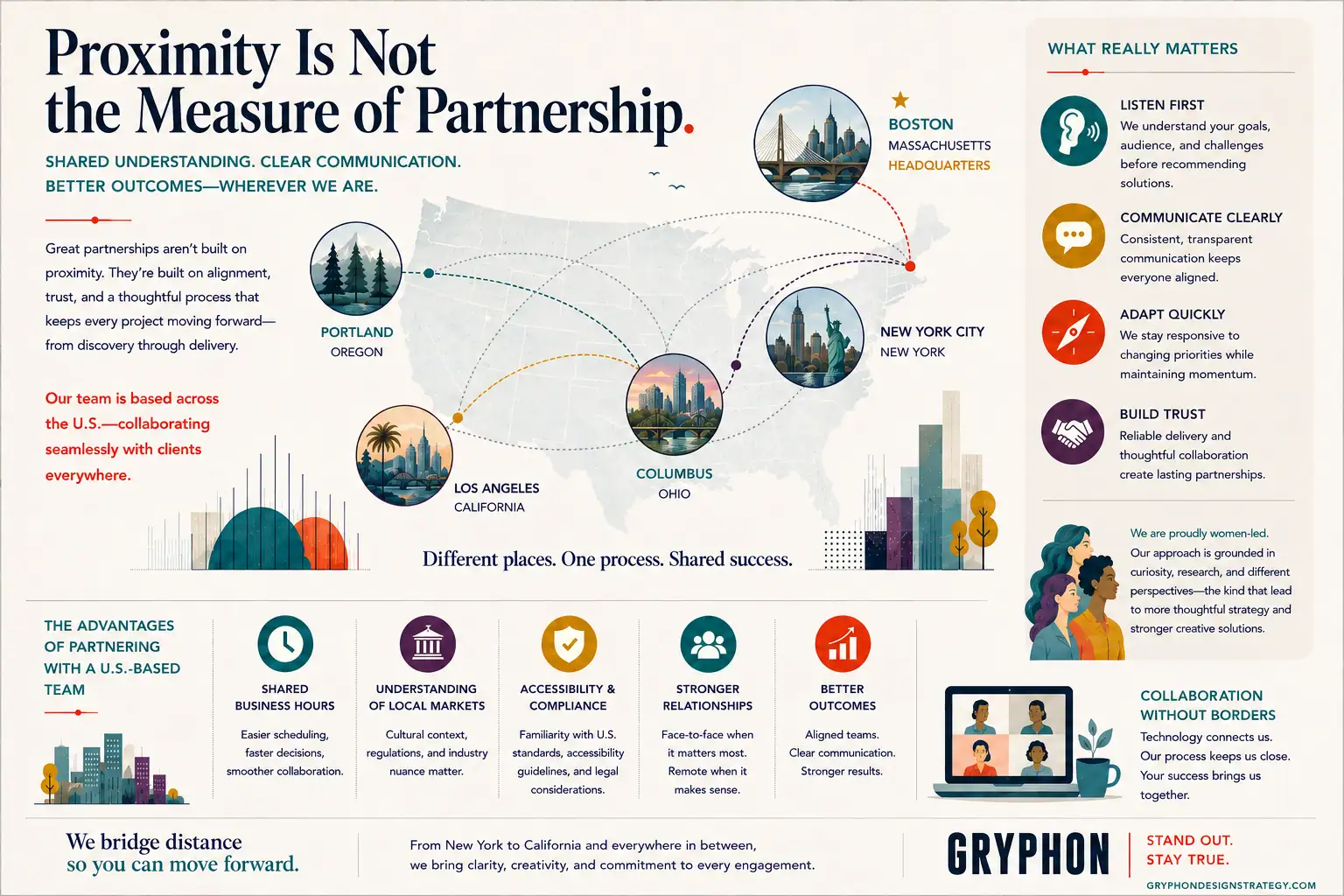
Why Being US-Based Still Has Value
Remote collaboration may have expanded the map, but there are still meaningful advantages to working with a US-based creative partner. Shared business hours make conversations and decisions easier to coordinate. Familiarity with regional markets, accessibility standards, legal and regulatory considerations, and cultural context can reduce unnecessary friction - particularly when the work involves nuance, timing, or compliance.
Those advantages can be especially useful for organizations in healthcare, higher education, technology, and other regulated or complex sectors. Being US-based is not valuable simply because of geography. Its value is practical: it can create a more fluid working relationship while still allowing organizations to choose the partner whose expertise and perspective best fit the work.
Beyond the Address
Location is only one part of the equation. How an agency works matters far more than where its office happens to be. When you are evaluating a creative partner, the more useful questions are about the relationship you will actually experience:
- Do they listen before recommending solutions?
- Do they take time to understand your organization and audience?
- Will senior leadership remain involved as the work develops?
- Can they adapt to changing priorities without losing the strategy behind the project?
- Do their communication and review processes make it easy for your team to participate?
Those qualities shape a partnership over months and years. They also reveal something a map cannot: whether the agency has built a process around keeping people, ideas, and decisions connected.
Perspective Travels Well
Organizations also look for partners whose perspective and working style align with their culture. Gryphon is women-led, and that experience has reinforced something we believe matters in every engagement: no single perspective is ever enough. Stronger work comes from intentionally seeking out viewpoints beyond our own through research, listening, curiosity, and collaboration.
That does not mean assuming we understand every audience because of who we are. It means approaching the work with enough humility to ask better questions and enough discipline to learn before we recommend. Different perspectives can challenge assumptions, expose blind spots, and reveal opportunities that might otherwise be missed. For us, that mindset is less about a label than about how we work.
Collaboration Without Borders
Today’s best creative partnerships are rarely limited by geography. Whether a client is across town or across the country, success depends on clear communication, shared goals, and a process designed to keep everyone connected. Remote collaboration works especially well when expectations are clear, reviews are purposeful, decisions are documented, and the right people remain involved throughout the engagement.
That kind of process turns distance from a compromise into flexibility. It allows organizations to choose the team that best fits the challenge rather than defaulting to the closest option, while still maintaining the continuity, responsiveness, and personal connection that good creative work requires.
The Gryphon Perspective
Our headquarters are near Boston, Massachusetts, with satellite offices in Columbus, Ohio, Rochester, New York, and Los Angeles, California. Every project is led by our US-based team, and our collaborative process was built to support organizations across the United States. That directly answers two practical questions clients often ask: yes, our team is US-based, and yes, we can work together seamlessly if you are not local.
More importantly, our methodology has been refined through years of remote and hybrid collaboration. Strategic leadership, thoughtful communication, and consistent involvement keep each engagement aligned from discovery through delivery, while the process adapts to the client’s team, priorities, and way of working.
For us, the most important distance is not measured in miles. It is the distance between ideas and understanding. Our job is to keep that distance as short as possible.
FIELD NOTE
When comparing creative partners, do not start by drawing a radius around your office. Start by asking how you want the relationship to feel. Look for the team that communicates clearly, understands your organization, stays engaged, and makes collaboration easier. Geography can support a partnership. It should not define it.
Looking for a Creative Partner?
Whether you are looking for a local agency or exploring partners across the country, the most useful question is not simply where they are located. It is how they work. If you are curious whether Gryphon is the right fit for your organization, we would be happy to start the conversation.