
Creative work asks something unusual of all of us: bring everything you know into the room, then stay open to something you haven’t considered yet.
You know your organization in ways we never will. We bring distance, curiosity and the ability to notice what may be harder to see when you live with it every day. Neither side has the whole answer.
After years of working this way, three things continue to make the difference.
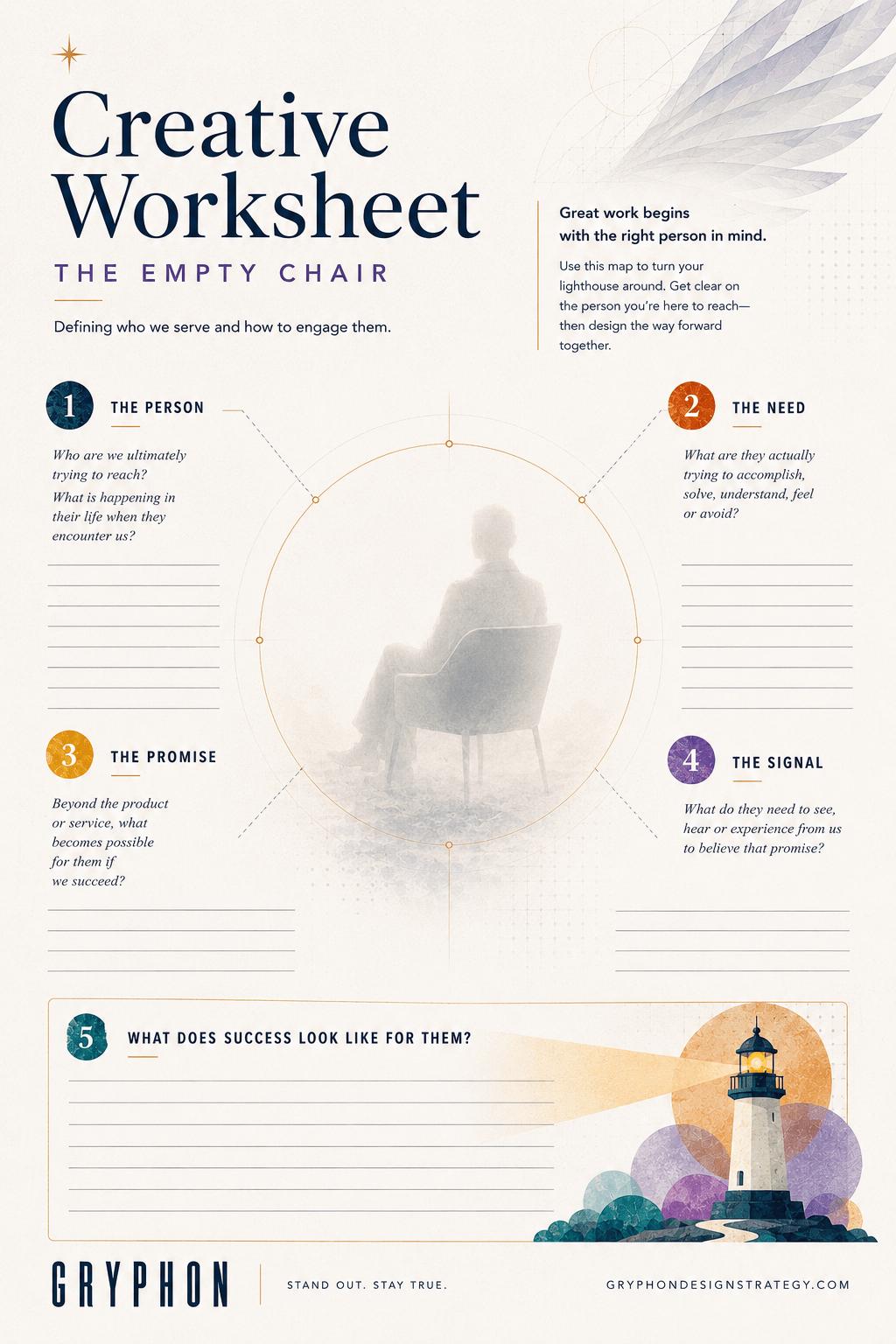
1. Keep the empty chair.
We’re often invited into organizations doing things with enormous implications. And those implications are deeply human.
In a business consumed by strategy, technology, operations and growth, it can be surprisingly easy to lose sight of the person all that work is meant to serve.
A person hoping to be matched with the right clinical trial. A baby experiencing a better spinal tap because of a product our client developed. A grandmother aging safely at home with a medical alert device. A family turning on the lights without ever knowing about the technology helping reinforce the grid.
So I like to keep an empty chair at the table. Whoever belongs in that chair changes from project to project. The responsibility doesn’t.
At Gryphon Design Strategy, we care deeply about that connection. Because ultimately, you’re not just selling a product or service. You’re offering someone a solution—and a promise of what might be possible.
That promise is what we’re trying to give form to.
2. Create room to explore.
I’ve always tried to create a secure, supportive culture where people can fail safely. When people feel trusted, they’re more willing to explore ideas instead of worrying about how they’re performing in the room. That creates room for genuine innovation.
The unfinished thought makes it onto the table. Someone questions the senior person in the room. A junior designer sees something I missed. A client challenges our direction. Any of us can change our minds when the work tells us to.
I’ve seen that hold true across very different creative teams—from global design organizations at Nike and adidas to the practice we’ve built at Gryphon. The scale changes. The principle doesn’t: the strongest work happens when talented people feel trusted enough to contribute fully and secure enough not to need credit for being right.
That’s also why I sometimes tell clients, “You pay me too much to just agree with you.”
If you’ve invited us inside your organization, you deserve more than affirmation. You deserve our experience, curiosity and independent point of view—even when that means raising something uncomfortable. And that goes both ways.
Tell us what isn’t working. What you’re afraid of losing. What keeps you up at night. Tell us the thing you almost didn’t tell us. If the answer is “I don’t know yet,” that’s useful information too.
The goal isn’t for either of us to win. The goal is for the work to get better.
3. Keep the lighthouse visible.
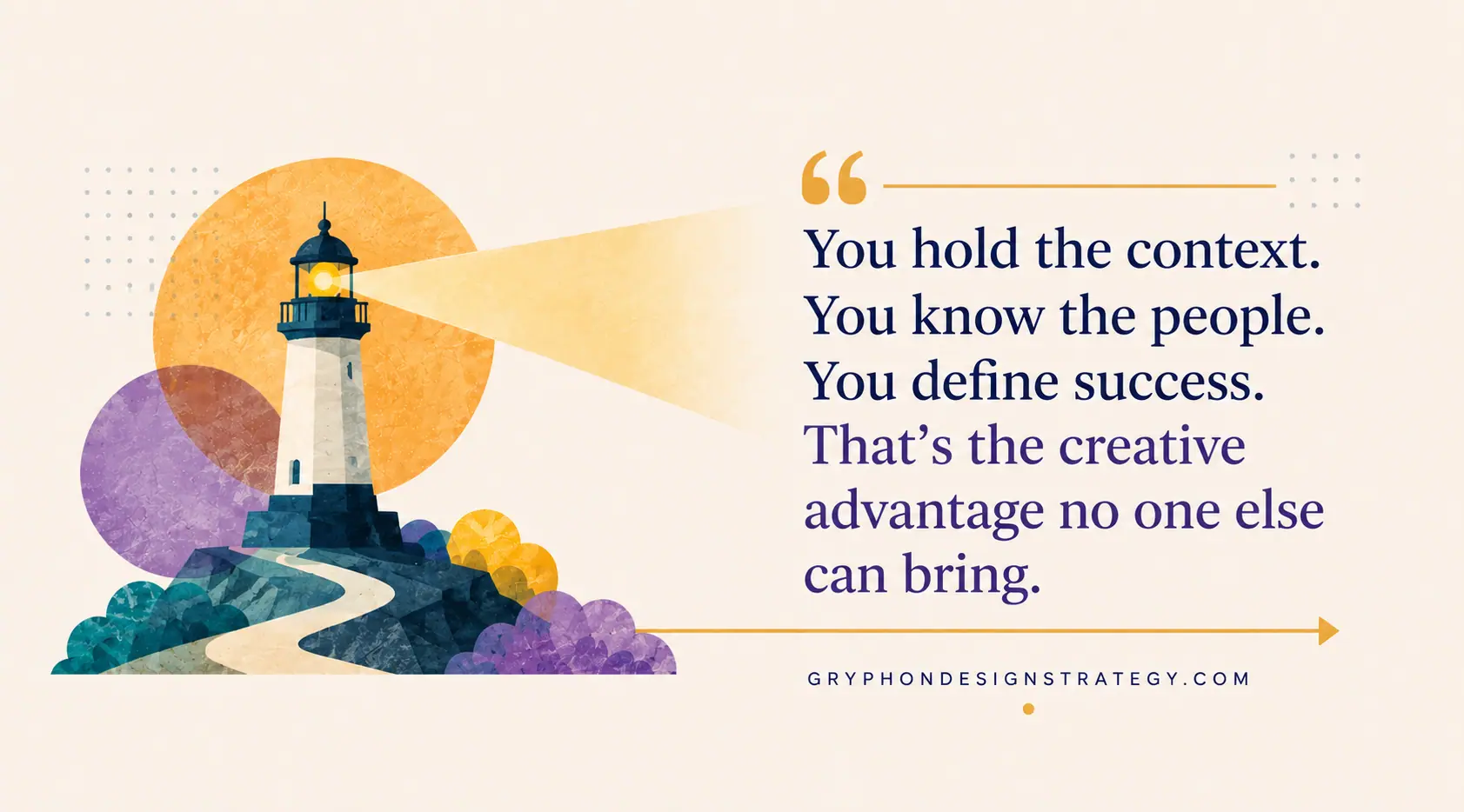
There is something only leadership can give us: a clear sense of where we’re trying to go.
What does success look like?
Give us that destination. Leadership doesn’t have to prescribe every turn in the route. Keep the lighthouse visible, and trust the people around the table to help find the way.
You trusted us first.
There is one part of this partnership I never want to take for granted: before any of that trust is returned, you invited us in.
You’re trusting us with unfinished thinking, confidential information, internal challenges and possibilities that may not even be ready to say out loud yet. Ultimately, you’re trusting us with how people may discover, understand and remember something you’ve spent years building.
We know you have choices. You chose us. We take that trust seriously.
We’ll listen carefully, tell you what we really see, change our minds when we should—and keep that empty chair with us throughout the work.
Our job is to earn your trust and make something worthy of theirs.
Before We Meet
Not a brief. Not homework. Just a few things worth thinking about. “I don’t know yet” is a perfectly useful answer.
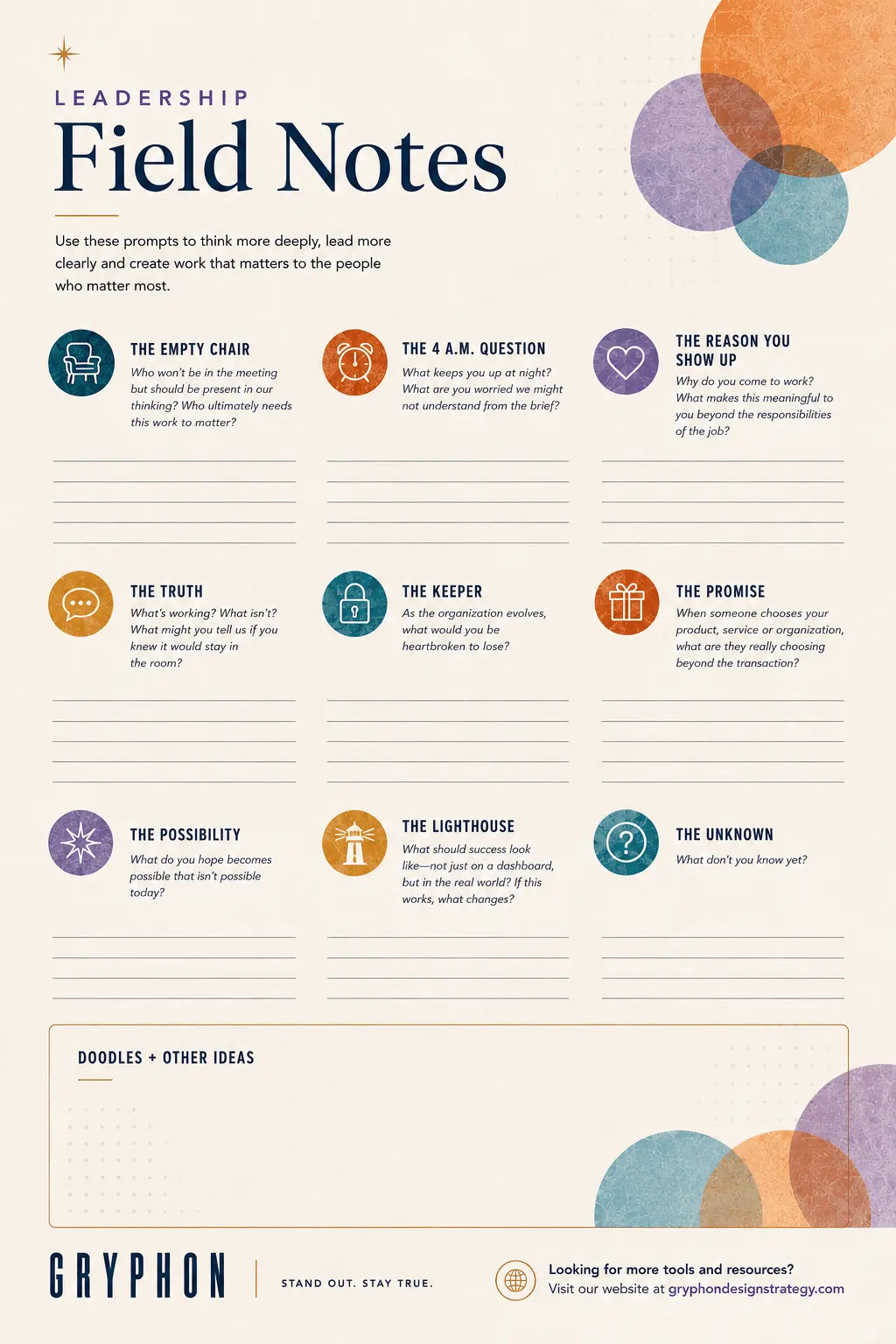
THE EMPTY CHAIR Who won’t be in the meeting but should be present in our thinking? Who ultimately needs this work to matter?
THE 4 A.M. QUESTION What keeps you up at night? What are you worried we might not understand from the brief?
THE REASON YOU SHOW UP Why do you come to work? What makes this meaningful to you beyond the responsibilities of the job?
THE TRUTH What’s working? What isn’t? What might you tell us if you knew it would stay in the room?
THE KEEPER As the organization evolves, what would you be heartbroken to lose?
THE PROMISE When someone chooses your product, service or organization, what are they really choosing beyond the transaction?
THE POSSIBILITY What do you hope becomes possible that isn’t possible today?
THE LIGHTHOUSE What should success look like—not just on a dashboard, but in the real world? If this works, what changes?
THE UNKNOWN What don’t you know yet?
Continue Exploring
We’re forever learning, and some of our best lessons have come through the people we’ve had the privilege to call our clients. Their expertise, perspective and engagement helped us refine our own practice.
From people we’ve had the privilege to work with
Carol Kauffman + David Noble — Real-Time Leadership
Kauffman and Noble explore how leaders can respond when the stakes are high, circumstances are changing and there is no obvious answer. Douglas Choo joined them on the companion Real-Time Leadership Playbook. Carol, David and Douglas are all former Gryphon branding clients, and their work has helped sharpen our own thinking about leadership, clarity and judgment.
Carol Kauffman + Amy Edmondson — Psychological Safety in Tumultuous Times
A conversation from the Institute of Coaching on why psychological safety matters when uncertainty is high — and how environments that support speaking up, questioning and contribution create better conditions for innovation, creativity and teamwork.
More on trust, exploration + creative partnership
Amy Edmondson — It’s OK to Fail, but You Have to Do It Right
A useful distinction between preventable mistakes and the intelligent experimentation required to discover something new — and why psychological safety matters when people are taking smart risks.
Spencer Harrison — How to Give and Receive Feedback About Creative Work
A research-backed look at why useful creative feedback provides direction without prescribing the solution, leaving room for the work to evolve rather than simply execute a requested fix.
IDEO — Stepping Out to Leap Forward
A practical perspective on building psychological safety between creative teams and clients so people can take risks, admit uncertainty and work in genuinely new ways together.
Ebony Simone Morczinek — Leadership, Voice + Psychological Safety
A Black woman executive’s perspective on the high-wire act of leadership in fast-moving organizations — and why voice, authenticity and safety do not land the same way for everyone in the room.
Dr. Nicole D. Vick — Lived Experience, Psychological Safety + Public Health
A public-health leader’s perspective on courage, mentorship and lived experience, including how being overlooked in the workplace shaped her research on psychological safety for Black public-health professionals.
Follow Dr. Nicole D. Vick on LinkedIn