
The people who shape the strategy should remain connected to the work.
When organizations begin searching for a branding or web design agency, they often compare portfolios, capabilities, industry experience, and pricing. Those are all important considerations. But one of the most important questions often goes unasked: who will actually be doing the work?
Many agencies introduce prospective clients to experienced strategists and creative leaders during the sales process. Once a project begins, however, much of the day-to-day work may be delegated to teams that weren't part of those early conversations. Those teams may include external production partners or subcontractors who support delivery but aren't directly involved in the ongoing strategy, collaboration, or decision-making behind your account.
There is nothing inherently wrong with this approach; many agencies use it successfully. The important thing is understanding how your project will actually be delivered—and what that means for communication, continuity, and outcomes.
Experience matters. So does access to it.
Experience is valuable because it changes the quality of the questions being asked. Senior leaders who have worked across brand strategy, websites, UX, accessibility, content strategy, and marketing communications recognize patterns more quickly, anticipate risks earlier, and understand how one decision can affect the rest of the system.
But experience only creates value when it is actually present in the engagement. A leadership team may have decades of experience on paper; what matters to the client is whether that judgment remains accessible when priorities shift, a difficult decision appears, or the work needs to be challenged rather than simply completed.
That distinction is especially important on complex engagements. The strongest teams do more than know how to make the work. They understand when to question the brief, when to protect what is already working, and when a seemingly small decision may have larger consequences for the brand, the website, or the organization behind it.
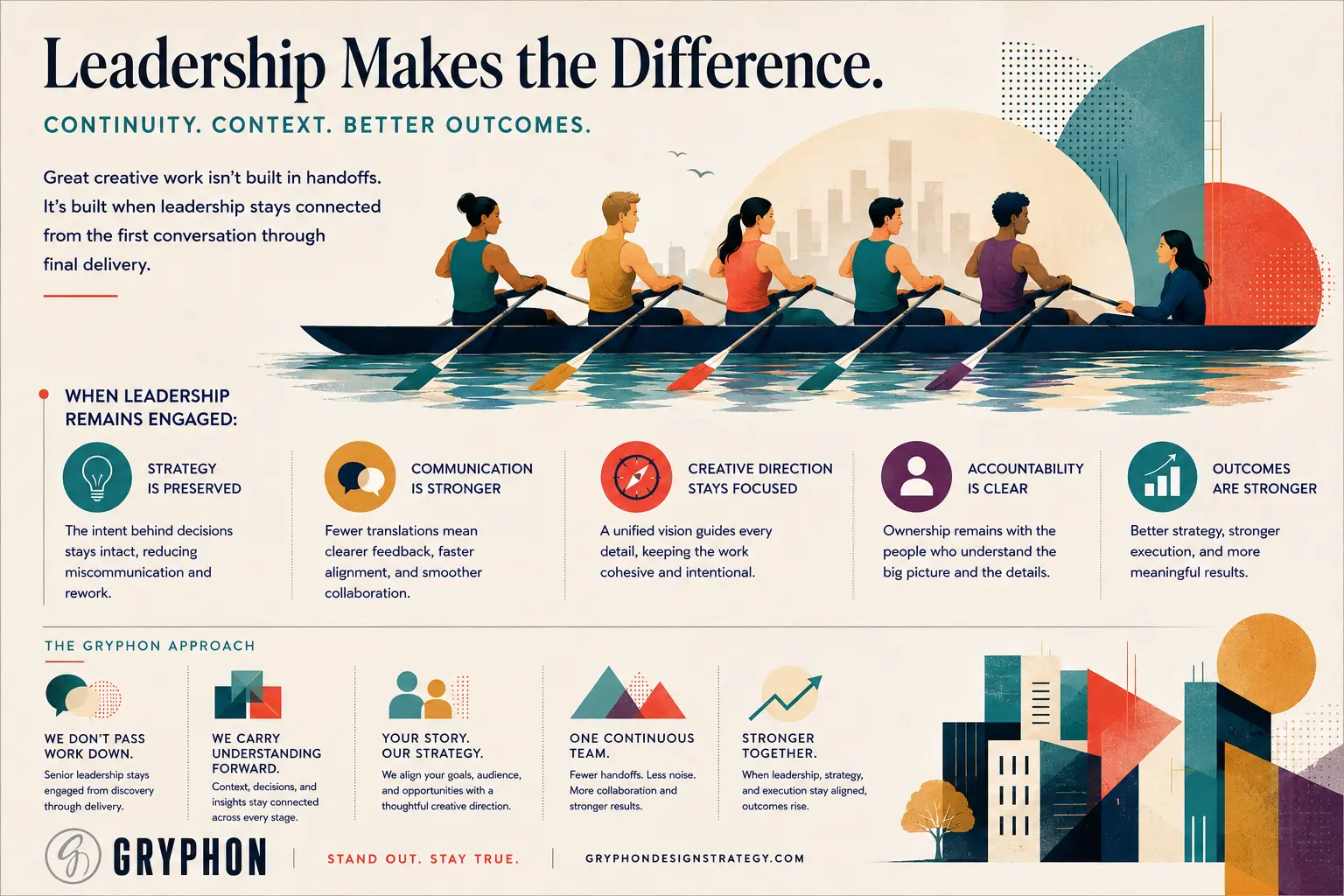
Every handoff changes the conversation
Creative work doesn't simply move through hands; it moves through understanding. Discovery meetings uncover insights that rarely make it into a project brief. A leadership discussion reveals a business priority. A customer interview changes the direction of a message. A casual comment during a workshop sparks an entirely new idea. These moments often shape the strongest work because they are understood by the people who were there, even when they never become a formal bullet point in the notes.
As projects move through additional layers, that understanding can gradually become compressed. Objectives become summaries, conversations become notes, and feedback becomes interpretation. Each handoff requires someone to translate what came before. Even with talented people and the best intentions, every translation creates another opportunity for context to become simplified, delayed, or misunderstood.
The challenge isn't where people work or whether a specialist is internal or external. It's whether the people making decisions are connected to the strategy, conversations, and context that shaped the work from the beginning.
Why continuity matters
Strong creative work isn't produced by following instructions. It's produced by understanding why those instructions exist. When the people who help define the strategy remain engaged throughout the project, questions can be answered with context instead of assumptions, and ideas can evolve without repeatedly reconstructing the reasoning behind earlier decisions.
Clients spend less time repeating themselves, teams spend less time revisiting decisions, and projects maintain momentum. Perhaps most importantly, strategy and execution remain connected. The thinking developed during discovery continues to inform every review, recommendation, refinement, and final deliverable.
That continuity often leads to work that feels more thoughtful and cohesive, not because fewer people are involved, but because the people involved are working from the same understanding.
Questions worth asking any agency
Every agency has its own delivery model, and there is no single right approach. Before choosing a creative partner, it is worth understanding how your project will actually be managed and where senior judgment enters the process.
- Who will lead strategy throughout the engagement?
- Who will be my primary point of contact?
- Will the people presenting the proposal remain involved after kickoff?
- Who is responsible for creative decisions?
- How often does senior leadership review the work?
- How are outside specialists integrated into the process?
- How many layers are between my team and the people creating the work?
These questions aren't meant to compare agencies against one another. They're meant to help you understand how decisions are made, how communication flows, and how your organization will be supported throughout the engagement.
The Gryphon Perspective
At Gryphon Design Strategy, continuity isn't simply a feature of our process; it's part of how we protect the thinking behind the work. Our leadership team brings decades of experience across branding, websites, UX, accessibility, content strategy, and marketing communications, with work ranging from startup launches to enterprise transformations.
Michele remains actively involved in every engagement, providing strategic direction, creative leadership, and quality oversight from discovery through delivery. The same senior perspective that helps frame the problem remains connected as strategy becomes design, design becomes execution, and the work moves into the world.
That doesn't mean one person does everything. The right specialists still bring their expertise where it matters. What stays constant is the connection between those specialists, the leadership guiding the engagement, and the goals established with the client from the beginning.
Our collaborative approach has been refined through years of partnering with organizations across healthcare, technology, higher education, nonprofits, consumer brands, and emerging companies. The methodology adapts to each client's goals, audience, and way of working while preserving the continuity that turns insight into thoughtful, cohesive solutions.
The people behind the work matter
The right agency isn't simply the one with the strongest portfolio. It's the one with the right people, the right experience, and a way of working that supports your organization from the first conversation through the final deliverable.
If you're exploring a new brand, website, campaign, or long-term creative partnership, we'd be glad to share how Gryphon approaches the work and learn more about what you're hoping to achieve.